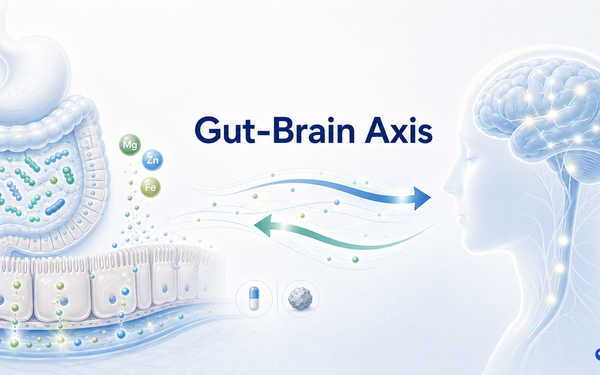
Chronic Headaches That Won't Quit? You Might Be Missing Magnesium
You know this routine: head starts pounding, you reach for a paracetamol, and an hour later you feel fine. Then it's back the next day. And the week after. The pill bottle migrates into your bag, your desk drawer, your bedside table.
You probably know that taking it this often isn't ideal. But when the pain hits, nothing else feels practical.
Here's a question that very few doctors have ever asked you: "Could you be magnesium deficient?"
It's not that the question is wrong. Modern medicine has simply been trained to treat symptoms faster than it seeks root causes. A paracetamol clears the pain in 45 minutes. A conversation about nutritional biochemistry takes much longer — and it doesn't appear on a prescription pad. (A small note: magnesium is a micronutrient, squarely in the domain of nutrition.)
This article will explain why magnesium deficiency causes chronic headaches at the level of biological mechanism — and why understanding that could change everything about how you approach pain that keeps coming back.
What Is Magnesium and Why Does It Matter for Your Brain?
Before we get to headaches, it helps to understand magnesium's foundational role in the body.
Magnesium (Mg²⁺) is a cofactor — an essential catalyst — for more than 600 enzyme reactions in the human body. More critically: every molecule of ATP (adenosine triphosphate, the cell's energy currency) must exist as a Mg-ATP complex to have actual biological activity. Without magnesium, cells cannot properly use energy — no matter how many calories you consume.
For the nervous system specifically, magnesium plays a unique role: it acts as the physiological blocker of the NMDA receptor (N-methyl-D-aspartate receptor), the brain's most important calcium channel. Think of magnesium as a security guard at the gate, only allowing calcium to enter when two signals arrive simultaneously. When magnesium is depleted, that guard disappears — calcium floods into neurons continuously, and the brain enters a state of chronic hyperexcitability: background anxiety, a lowered pain threshold, and recurring headaches.
The Physiology Behind Magnesium Deficiency and Chronic Headache
Disrupted Vascular Balance in the Brain
To understand how magnesium deficiency causes headaches, one principle is key: calcium and magnesium are opposing forces that together regulate vascular tone.
Ca²⁺ ions activate smooth muscle contraction in vessel walls (vasoconstriction), while Mg²⁺ antagonizes calcium and promotes relaxation (vasodilation). Under normal conditions, these forces are balanced — cerebral blood vessels dilate and contract rhythmically, blood flow is stable.
When magnesium is low, this balance tips toward calcium. Smooth muscle in vessel walls lacks sufficient counter-pressure → uncontrolled vasospasm. Because cerebral blood flow is not perfectly symmetric, dominant spasm on one side → localized perfusion drop → the unilateral, throbbing pain that characterizes migraine.
The clinical evidence supporting this is strong. A randomized controlled trial by Peikert et al. (1996), published in Cephalalgia, enrolled 81 migraine patients who received 600 mg of magnesium daily for 12 weeks. The result: migraine frequency fell by 41.6% in the magnesium group versus 15.8% in the placebo group (p < 0.05). Based on this and similar trials, in 2012 the American Academy of Neurology (AAN) and American Headache Society elevated magnesium supplementation to Level B evidence for episodic migraine prevention ("probably effective and should be considered").
The Trigeminal Nerve — The Keystone of Chronic Headache
The second mechanism is less discussed but equally important: magnesium stabilizes the ganglion of cranial nerve V (the Trigeminal Nerve — Nervus Trigeminus), which carries sensation from the face, temples, and crown of the head.
Magnesium blocks NMDA receptors at the trigeminal ganglion. When deficiency sets in, the "guard" is absent → the nerve ganglion becomes prone to overactivation and inflammation. This underlies Cortical Spreading Depression — a wave of neural excitation that has been confirmed as the central mechanism of migraine with aura (the visual disturbances or sensory changes that precede the headache). A study measuring magnesium concentrations in the cerebrospinal fluid of migraine patients during an attack found Mg²⁺ levels significantly lower than in controls.
Symptoms escalate with severity: a dull, one-sided ache with temporal heaviness (mild deficiency) → classic migraine with nausea, photophobia, and phonophobia (moderate) → severe, incapacitating pain lasting 4–72 hours (severe deficiency with ganglion inflammation).
The Real Problem with Paracetamol for Chronic Headaches
Paracetamol inhibits prostaglandin synthesis centrally and reduces pain signaling — those are real effects. What it does not do: resolve vasospasm, stabilize the trigeminal ganglion, or replenish magnesium.
When the drug clears your system after 4–6 hours, the underlying cause is unchanged — the pain returns. You'll reach for another tablet to keep the headache at bay.
The more dangerous issue: medication-overuse headache (MOH) is a well-documented clinical entity. When analgesics are used on more than 10–15 days per month continuously, the medication itself becomes a driver of chronic daily headache. Many patients are caught in this cycle without realizing it.
Why Magnesium Deficiency Is So Common — Even If You "Eat Well"
This is the most important part for understanding the scale of the problem. Rosanoff et al. (2012) in Nutrition Reviews estimated that nearly 50% of the US population does not meet daily magnesium requirements from food alone. In Vietnam, with rapid urbanization and shifting dietary patterns, the figure is unlikely to be much lower.
Four main mechanisms explain why magnesium depletion has become pervasive in modern society.
Nutrient-depleted soil. Industrial monoculture farming does not adequately replenish soil minerals. Comparative data on British produce from 1940 to 2002 showed meaningful declines in magnesium content across vegetables within just a few decades. You eat your greens — but where do those greens get their magnesium when the soil is exhausted?
Food processing strips magnesium out. Magnesium is concentrated in the bran and germ of grains. Milling white rice and white flour removes most of it. Ultra-processed packaged foods — the backbone of urban diets — contain virtually no meaningful magnesium.
Chronic stress burns through magnesium biochemically. Every time the adrenal glands secrete cortisol, cortisol signals the kidneys to excrete more magnesium. This creates a dangerous spiral: chronic stress → more magnesium excreted → magnesium deficiency → NMDA receptors left unblocked → brain becomes more reactive → worse stress. This is the biochemical reason why highly stressed people tend to get more headaches — and why those headaches don't improve with rest alone.
Caffeine, alcohol, and common medications accelerate renal magnesium loss. Caffeine inhibits magnesium reabsorption in the renal tubules. Ethanol works similarly and also impairs intestinal magnesium absorption. Proton pump inhibitors (PPIs — omeprazole, pantoprazole), widely used for acid reflux, and thiazide diuretics, used for hypertension, both cause clinically significant magnesium depletion with long-term use.
Magnesium Bisglycinate vs. Magnesium Oxide — What's the Difference?
Not all magnesium supplements have equal clinical value. The salt form determines bioavailability (how much actually reaches circulation) and the target organ (whether the brain or heart benefits more from what's absorbed).
Magnesium oxide is the cheapest and most widely sold form — and has a bioavailability of only around 4%. That means for every 500 mg of magnesium oxide you swallow, your body absorbs roughly 20 mg. The rest passes through and can cause diarrhea. It may have an occasional role for constipation, but it's poorly suited for addressing systemic deficiency.
Magnesium bisglycinate (glycinate) is a chelate form — the magnesium ion bound to the amino acid glycine — with substantially higher bioavailability and minimal digestive side effects. Glycine itself is an inhibitory neurotransmitter, adding its own gentle calming effect.
For neurological symptoms such as chronic headache and migraine, Magnesium L-Threonate deserves special mention: it has a better ability to cross the blood-brain barrier, increasing magnesium concentrations directly in brain tissue. Research on this form is still emerging and the evidence base is smaller than for glycinate, but the mechanistic rationale is compelling.
| Magnesium form | Bioavailability | Best suited for |
|---|
| Bisglycinate | High | Whole-body deficiency, insomnia, cramps, dysmenorrhea |
| L-Threonate | High — brain-targeted | Chronic headache, migraine, anxiety, cognitive support |
| Taurate | High — heart-targeted | Palpitations, arrhythmia |
| Malate | Moderately high | Chronic fatigue, muscle pain |
| Citrate | Moderate | Constipation, general maintenance |
| Oxide | ~4% | Not recommended for systemic supplementation |
The Magnesium–Calcium–Vitamin D Triangle: An Inseparable System
You can't talk about magnesium in isolation from this trio.
Both activation steps of Vitamin D in the body — at the liver (25-hydroxylase) and at the kidney (1α-hydroxylase) — are entirely dependent on magnesium as a cofactor. A randomized clinical trial by Dai et al. (2018) in the American Journal of Clinical Nutrition, with 180 participants, demonstrated that magnesium status significantly influences vitamin D metabolism. People taking high-dose vitamin D while simultaneously deficient in magnesium may not see the expected rise in their 25(OH)D levels, because the conversion enzyme lacks its required cofactor.
Practical takeaway: if you're supplementing vitamin D diligently but your 25(OH)D levels aren't responding, check your magnesium status before increasing your D dose.
How to Supplement Magnesium for Chronic Headaches
Dosage. Migraine trials have used 400–600 mg of elemental magnesium daily, maintained for at least three months before evaluating effectiveness. Those under high chronic stress or with heavy exercise loads may need 600–800 mg. The standard RDA for adults is 310–420 mg depending on sex and age.
Timing. Take half the daily dose in the evening, 30–60 minutes before bed (to leverage magnesium's muscle and neural relaxation effects). Take the other half in the morning or at lunch. Space at least 1–2 hours apart from calcium supplements to avoid competitive absorption.
Testing. Standard serum magnesium testing is not sensitive enough to detect deficiency — only around 1% of total body magnesium circulates in the blood; 99% is stored in bone and inside cells. You can be significantly depleted while your lab result reads "normal." RBC magnesium (red blood cell magnesium) is a more accurate reflection of cellular magnesium status.
Food sources. Pumpkin seeds (~150 mg/28g), almonds (~80 mg/28g), cooked spinach (~78 mg/½ cup), brown rice (~84 mg/cooked cup), black beans (~60 mg/½ cup), dark chocolate ≥70% (~65 mg/28g). Practical caveat: industrially grown produce may contain 20–35% less magnesium than standard reference values due to mineral-depleted soil.
Patience. Magnesium is not a painkiller. The preventive effect on migraines typically becomes apparent after 8–12 weeks of consistent supplementation. This is root-cause treatment, not acute symptom relief.
Summary
Chronic headaches and migraines may be symptoms of magnesium deficiency — through cerebrovascular vasospasm caused by calcium–magnesium imbalance, and through trigeminal ganglion hyperactivation from unblocked NMDA receptors. Paracetamol suppresses the pain signal; magnesium addresses the underlying cause.
Using analgesics on more than 10–15 days per month can itself cause chronic daily headache (medication-overuse headache) — a trap many patients are in without knowing it.
Magnesium deficiency is widespread and underappreciated: depleted soils, processed food, chronic stress, caffeine, alcohol, and commonly prescribed medications all systematically drain magnesium. Standard serum testing does not reliably detect it — RBC magnesium testing or comprehensive symptom assessment is needed.
If you're reaching for paracetamol more than 4–5 times a month — especially when headaches come alongside night cramps, poor sleep, palpitations, or muscle twitching — this is a compelling reason to discuss your magnesium status with your doctor before escalating to stronger medication.
References
- Peikert A et al. "Prophylaxis of migraine with oral magnesium: results from a prospective, multi-center, placebo-controlled and double-blind randomized study." Cephalalgia 16(4): 257–263, 1996. PubMed
- Holland S et al. "Evidence-based guideline update: NSAIDs and other complementary treatments for episodic migraine prevention in adults." Neurology 78(17): 1346–1353, 2012. PubMed
- Ramadan NM et al. "Low brain magnesium in migraine." Headache 29(7): 416–419, 1989.
- Tarleton EK et al. "Role of magnesium supplementation in the treatment of depression: a randomized clinical trial." PLOS ONE 12(6): e0180067, 2017. PubMed
- Boyle NB et al. "The effects of magnesium supplementation on subjective anxiety and stress — a systematic review." Nutrients 9(5): 429, 2017. PMC
- Dai Q et al. "Magnesium status and supplementation influence vitamin D status and metabolism: results from a randomized trial." American Journal of Clinical Nutrition 108(6): 1249–1258, 2018.
- Lötscher J et al. "Magnesium sensing via LFA-1 regulates CD8+ T cell effector function." Cell 185(4): 585–602, 2022. PubMed
- Rosanoff A et al. "Suboptimal magnesium status in the United States: are the health consequences underestimated?" Nutrition Reviews 70(3): 153–164, 2012. PubMed
- Diener HC et al. "Medication-overuse headache: a worldwide problem." Lancet Neurology 3(8): 475–483, 2004.
This article is for educational purposes based on peer-reviewed evidence. It is not a substitute for medical advice. Before changing any medication regimen or beginning therapeutic-dose supplementation, consult a qualified healthcare professional.