

Only in Vietnamese
Gut-brain axis: tại sao hấp thụ vi chất phụ thuộc tiêu hóa
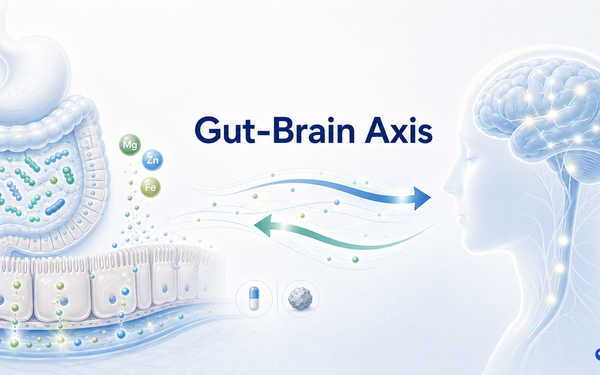
Đường ruột khỏe mạnh quyết định bao nhiêu % vi chất bạn hấp thụ. Hiểu gut-brain axis, vai trò probiotic và tại sao dạng chelate vượt trội khi tiêu hóa yếu.
You lost 5 kilos. Your clothes are looser. But looking in the mirror, your belly is exactly the same.
A lot of people have been through this. Eating less, walking every day, the body visibly slims down overall — but the abdominal area seems to receive no signal at all. Fat disappears from the arms, face, and legs first. Belly fat just stays.
This isn't a lack of discipline or effort. It's biology, and there's a specific name for it.
If you've been struggling with stubborn belly fat despite losing weight elsewhere, you need to understand what's actually happening before you change anything. This article is fairly long, but for many people it will be the first time they truly understand why their body is doing this.
In medicine, this is called MONW — Metabolically Obese Normal Weight. The popular term "skinny fat" describes exactly what it looks like on the outside: a person who appears lean or normal-weight but carries a high percentage of body fat, particularly visceral fat accumulated around the organs inside the abdomen.
A study published in the International Journal of Obesity (2017) described MONW individuals as "thin in appearance but not metabolically healthy": they showed lower insulin sensitivity, higher visceral fat, and a less favorable lipid profile compared to people with the same BMI who didn't have the condition.
MONW prevalence ranges from 5% to 45% depending on diagnostic criteria and population group. People of Asian descent — including Vietnamese — are at higher risk due to differences in body composition: at the same BMI, they tend to carry a higher proportion of visceral fat than their Western counterparts.
What makes MONW particularly concerning: a normal BMI masks the real risk. Routine blood tests may look fine. But underneath, visceral fat is quietly driving chronic inflammation, insulin resistance, and increased cardiovascular risk.
The answer starts with how the body decides where to burn fat.
When you eat — especially high-glycemic foods — the pancreas releases insulin. And insulin has a very specific effect on fat burning: it switches off the fat-breakdown enzyme.
That enzyme is hormone-sensitive lipase (HSL). Its job is to cut triglyceride molecules in fat cells into glycerol and free fatty acids, which is the first step of fat burning. Adrenaline activates HSL. Insulin suppresses it.
If you're cutting calories but still eating white rice, bread, and sugar, insulin is still spiking multiple times a day. Every time insulin rises, HSL gets switched off. The body is in "storage mode", not "release mode."
The result: the body can lose weight through water loss, muscle loss, and burning small amounts of fat in areas less sensitive to insulin — but visceral abdominal fat, which is highly insulin-sensitive, is the last region to be mobilized.
Aggressive calorie restriction is a form of physiological stress. The body responds by increasing cortisol output from the adrenal glands.
Cortisol has an evolutionary purpose: maintain blood glucose when the body perceives danger. It breaks down muscle to supply amino acids for glucose production. And critically: it actively redistributes fat toward visceral depots, where it can be mobilized most quickly in a perceived emergency.
This is why people who lose weight through extreme means — severe restriction, excessive training, too little sleep — end up with thinner limbs but the same belly: chronically elevated cortisol is actively pumping fat toward the center.
Even when insulin is controlled and HSL is working, free fatty acids still haven't been burned. They need to enter the mitochondria and go through a chain of reactions called the Krebs cycle (also called the citric acid cycle or TCA cycle) to actually produce energy.
This is where micronutrient deficiency becomes the central problem.
Hans Krebs — a German-Jewish biochemist forced to flee Nazi Germany — discovered this metabolic cycle in 1937 and received the Nobel Prize in 1953. He described a loop of reactions occurring in the mitochondrial matrix, where all three macronutrients (carbohydrates, fats, and proteins) converge to produce ATP, CO2, and water.
The fat pathway:
Three rate-limiting enzymes control the speed of the entire cycle: citrate synthase, isocitrate dehydrogenase, and alpha-ketoglutarate dehydrogenase. None of them function normally without the right cofactors.
Step 2 — activating the fatty acid into acyl-CoA — requires Magnesium as a mandatory cofactor. Without magnesium, this reaction is blocked. The fatty acid has been released from the fat cell but cannot be "loaded" to enter the mitochondria and be burned.
This is why some people report sudden weight loss after starting magnesium supplementation despite no change in diet: the fat-burning machinery was always there, but it was missing the operating fuel.
Beyond magnesium, the Krebs cycle enzymes also require:
Someone aggressively cutting calories while eating a limited variety of foods is at risk of running low on several of these at once. When that happens, the Krebs cycle slows down. Fat gets mobilized but not effectively burned.
This is a fact most people trying to lose weight don't know.
Researcher Ruben Meerman and Professor Andrew Brown at the University of New South Wales calculated and published in the BMJ in 2014: when 10 kg of fat is fully oxidized, 8.4 kg (84%) leaves the body as CO2 through the breath. Only 1.6 kg becomes water, excreted through sweat and urine.
The lungs are the body's primary fat excretion organ.
What this means in practice: if the Krebs cycle is running slowly due to micronutrient deficiency, less CO2 is produced — meaning less fat is actually being burned, even while you're trying hard to eat less.
And if you breathe shallowly (common in people who sit for long hours or are chronically stressed), lung capacity decreases and CO2 clearance is limited — fat burning becomes less efficient as a result.
Visceral fat around the abdomen has a higher density of cortisol receptors and insulin receptors than subcutaneous fat on the limbs. This makes it more reactive to cortisol, meaning that when stress is prolonged, visceral fat accumulates preferentially. It's also harder to mobilize before insulin comes down — it requires a sustained period of low, stable insulin before breakdown begins. And it depends more on the Krebs cycle running well to actually be burned once mobilized.
In other words: belly fat is the last region to be oxidized in the metabolic chain — and it requires all three conditions to be met at the same time: low insulin, non-chronic cortisol, and a Krebs cycle with sufficient micronutrient cofactors to operate.
Cutting more calories doesn't solve the root problem. It can actually make things worse: insufficient intake drives cortisol up, which drives more belly fat accumulation.
The mechanism-based approach:
1. Control insulin throughout the day
Prioritize low-glycemic foods — vegetables, whole grains, protein, healthy fats. Every meal that doesn't cause a blood sugar spike is several more hours in which HSL is allowed to run.
2. Supply the micronutrients the Krebs cycle needs to operate
Magnesium is the top priority — especially for people who eat few vegetables, experience frequent stress, or drink a lot of coffee (caffeine increases urinary magnesium excretion). B vitamins, from food or a B-complex supplement, are essential for the Krebs enzymes.
3. Train in line with the fat-burning principle
Moderate-intensity aerobic exercise (30–40 minutes) is when the body preferentially burns fat through beta-oxidation and the Krebs cycle. Too high an intensity shifts fuel use toward glucose via anaerobic glycolysis, and fat goes untouched.
4. Manage cortisol
Getting adequate sleep is the simplest intervention for returning cortisol to its normal circadian rhythm. Excessive restriction and training without recovery are the two main drivers of chronic cortisol elevation.
Skinny fat is not a personal failure. It is the result of a tightly linked chain of biochemical mechanisms: insulin not low enough for HSL to work, elevated cortisol actively redirecting fat toward visceral depots, and a Krebs cycle short on micronutrient cofactors to burn the fat that has already been released.
Cutting more calories won't break that cycle. Understanding the mechanism and intervening at the right point can.
Content is educational and not a substitute for medical advice. Consult a professional before changing your supplement regimen.
References
Đường ruột khỏe mạnh quyết định bao nhiêu % vi chất bạn hấp thụ. Hiểu gut-brain axis, vai trò probiotic và tại sao dạng chelate vượt trội khi tiêu hóa yếu.
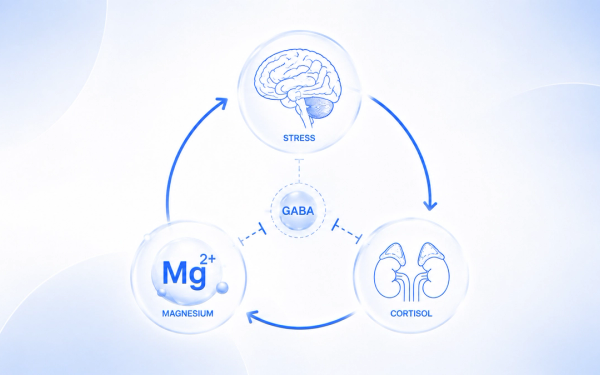
Stress mãn tính làm cơ thể tiêu thụ Magie nhanh gấp đôi. Hiểu cơ chế cortisol - GABA - Magie để giải thích tại sao căng thẳng kéo dài gây thiếu khoáng chất.

Mất ngủ khi mang thai không chỉ do bụng lớn hay đi tiểu đêm. Thiếu Magie và Vitamin D là hai yếu tố ít được nhắc tới nhưng có cơ chế rõ ràng. Bài này giải thích tại sao giấc ngủ thai kỳ bị phá vỡ, hai vi chất này liên quan thế nào, và giới hạn liều an toàn cần biết trước khi bổ sung.