

Only in Vietnamese
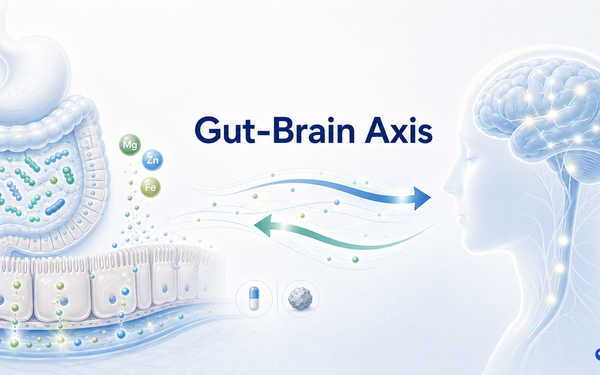
Gut-brain axis: tại sao hấp thụ vi chất phụ thuộc tiêu hóa
Đường ruột khỏe mạnh quyết định bao nhiêu % vi chất bạn hấp thụ. Hiểu gut-brain axis, vai trò probiotic và tại sao dạng chelate vượt trội khi tiêu hóa yếu.


You've done everything right: eating less, exercising more. Yet the scale barely moves. And you blame yourself for lacking patience, lacking discipline.
But the problem may not be willpower at all.
When you start losing weight, your body doesn't simply sit back and allow itself to be depleted. It responds systematically: automatically slowing how many calories it burns, amplifying hunger signals, and reducing unconscious movement. This is millions of years of evolutionary survival biology — not personal failure.
And if you're low on key micronutrients like magnesium, iron, vitamin D, or B vitamins, those self-defence responses become even stronger — because micronutrients are the "fuel" that powers the enzymes your body uses to burn fat.
This article breaks down both layers from an evidence-based perspective, in language anyone can follow.
Everyone knows the basic principle: to lose weight you need to burn more energy than you take in. This is called Energy Balance (EB):
Energy Balance = Energy In − Energy Out
When EB is negative (burning more than you consume), the body has to draw on stored fat. Thermodynamically, this is true.
The problem lies in the 7,700 kcal rule — a formula that has dominated weight-loss thinking for decades: "A deficit of 7,700 kcal equals 1 kg of fat lost." By that logic, cutting 500 kcal a day should deliver 1 kg of loss every 15 days, and 12 kg in six months.
Sounds reasonable. Almost no one achieves it.
Research by Hall et al. (The Lancet, 2011) showed the reality is far more complicated: every sustained 10 kcal/day reduction leads to roughly 0.45 kg of eventual weight change — but it takes nearly 1 year to reach half of that, and 3 years to reach 95%. Meaningful weight loss is slow, sustained work measured in years, not weeks.
Why? Because the moment you start eating less, your body reacts.
Every day your body spends energy through three main pathways:
| Channel | Share of daily burn | Plain English |
|---|---|---|
| RMR (Resting Metabolic Rate) | 60–70% | Energy used just to stay alive: heartbeat, breathing, brain function |
| DIT (Diet-Induced Thermogenesis) | 5–15% | Energy used to digest, absorb, and process the food you eat |
| PAEE (Physical Activity Energy Expenditure) | 10–20% | All movement: gym sessions, walking, even typing |
When you diet, you might expect only your calorie intake to change. What actually happens is all three channels fall simultaneously.
Research by Ravussin et al. (J Clin Invest, 1985) followed seven people with obesity through a very low-calorie diet. After losing 13.5% of their body weight, their total daily energy expenditure dropped by 18% — broken down as:
In other words, the body recalibrates its entire energy system — not just one component.
This is the most unsettling part: RMR doesn't just fall because you weigh less (which would be expected) — it falls more than your new body weight actually requires.
A meta-analysis by Prentice et al. (Proc Nutr Soc, 1991) across 31 studies found that people who have lost weight have a lower RMR than people of the same body weight who have never been heavier. This is called adaptive thermogenesis — the body deliberately turns down its furnace in response to the perceived threat of fuel shortage.
In everyday terms: if you drop from 70 kg to 60 kg, your 60 kg body burns fewer calories than someone who has always been 60 kg. You need to eat less than they do just to maintain the same weight — even though the scale shows the same number.
This is why so many people who successfully lose weight regain it rapidly — not because they "started eating more than before," but because their body has become a more fuel-efficient version of itself.
Beyond RMR falling, the body deploys at least three additional countermeasures:
Countermeasure 1: Hunger increases after exercise
When you exercise and burn extra calories, you expect to lose weight accordingly. But research by Whybrow (2008) showed the body compensates by driving you to eat more. Women burning an extra 693 kcal/day through exercise ate an additional 227 kcal — compensating 33%. Men burning 920 kcal ate an extra 287 kcal — compensating 31%.
Result: only about 67–69% of exercise-burned calories actually produce a deficit. The rest gets eaten back — not through lack of discipline, but because appetite-regulating hormones (leptin, ghrelin) are signalling the brain to refuel.
Countermeasure 2: Unconscious movement decreases without you noticing
A study by Riou et al. (Front Physiol, 2019) followed overweight women who began a structured aerobic exercise programme: within the very first week, their spontaneous physical activity outside of workouts (walking around, standing up, small fidgeting movements) decreased and stayed suppressed throughout training. The body redirects energy away from incidental movement to offset the structured exercise.
This is why many people who start going to the gym wonder why the scale won't budge — they don't realise they're sitting more and standing less for the rest of the day.
Countermeasure 3: Muscle loss drives RMR even lower
A meta-analysis by Garrow and Summerbell (Eur J Clin Nutr, 1995) across 23 trials found that roughly 25% of weight lost is muscle tissue, not fat. Since muscle is the primary driver of resting calorie burn, losing it creates a compounding feedback loop: less weight → less muscle → lower RMR → need to cut more calories to keep losing → more hunger → harder to sustain. A self-reinforcing disadvantage.
In a clinical trial (Lean, 2013), people eating just 810–833 kcal/day for 100 days had dramatically different outcomes: some lost almost nothing, others lost over 25 kg — under nearly identical conditions.
The degree of adaptive thermogenesis varies significantly between individuals, influenced by baseline metabolic rate, genetics, hormonal status, gut microbiome composition — and critically — micronutrient status.
That is the bridge to Part 2.
If Part 1 describes the body applying an automatic "brake" against weight loss, Part 2 explains why for many people that brake is tighter than it needs to be: micronutrient deficiencies impair the very enzymes and biochemical pathways the body uses to burn fat.
Recall the three core problems from Part 1:
Micronutrients affect all three, through very specific mechanisms.
Think of the mitochondria (the cell's energy-producing organelle) as a fat-burning furnace. For fat to be burned, it must pass through a precise sequence of steps inside that furnace.
The first step is "activating" fatty acids into a form the cell can process — called acyl-CoA. This reaction is carried out by an enzyme called acyl-CoA synthetase, and that enzyme requires magnesium (Mg²⁺) as a cofactor (a helper molecule without which it cannot function). Without enough magnesium, this activation step is blocked. Fat cannot enter the furnace to be burned, even if the furnace is otherwise running.
Inside the furnace, the Krebs cycle (also called the citric acid cycle — the core sequence of chemical reactions that extracts energy from fat, carbohydrates, and protein) has three rate-controlling enzymes that set the pace for the entire process. All three require magnesium:
When magnesium is low, all three run slowly. Research in Nutrients (Veronese et al., 2024) confirms: low magnesium impairs mitochondrial function, increases oxidative stress (ROS — Reactive Oxygen Species, damaging free radicals), and reduces fat oxidation efficiency. On top of an RMR already suppressed by adaptive thermogenesis (Part 1), this is an additional drag.
Magnesium and insulin resistance:
ATP (Adenosine Triphosphate — the cell's universal energy currency) must bind to magnesium to be biologically active (as MgATP). Low magnesium → the insulin receptor kinase functions poorly → insulin resistance worsens. Chronically elevated insulin suppresses hormone-sensitive lipase — the enzyme that releases stored fat for burning — meaning fat stays locked in storage even during a calorie deficit.
Barbagallo and Dominguez (World J Diabetes, 2015) confirmed: magnesium deficiency worsens insulin resistance and glucose metabolism — the exact central mechanism that makes weight loss difficult in people with obesity.
RMR is the rate at which your body burns calories at rest. The thyroid gland controls that rate through two hormones: T3 (Triiodothyronine) and T4 (Thyroxine).
To synthesise T3 and T4, the thyroid relies on an enzyme called TPO (Thyroid Peroxidase) — which catalyses the iodination step in thyroid hormone production. TPO is a heme-containing enzyme — it requires iron to function. Low iron → TPO activity drops → T3 and T4 production falls → the thyroid "burns" less brightly → RMR falls further than it otherwise would.
The evidence is direct: Beard et al. (Am J Clin Nutr, 1990) demonstrated that iron-deficient women had significantly lower T3 and T4 and measurably lower RMR — and supplementing iron restored both. A recent meta-analysis (Nutrients, Zhao et al., 2023) confirmed a positive correlation between serum ferritin (iron stores) and FT3/FT4 levels across multiple studies.
Iron also forms part of cytochrome c oxidase — the final enzyme in the mitochondrial electron transport chain, where oxygen is used to generate ATP from fat oxidation. Low iron → mitochondria are less efficient at converting fat into usable energy — compounding, at the cellular level, the RMR reduction already occurring from adaptive thermogenesis.
People with obesity tend to have lower blood levels of vitamin D than lean individuals — partly because adipose (fat) tissue stores vitamin D and traps it, leaving less available in circulation to perform signalling functions. The paradox: those who most need vitamin D's metabolic effects (people with high visceral fat and insulin resistance) are the ones with the least of it circulating in their blood.
This connects directly to weight loss through two mechanisms:
Insulin secretion: Vitamin D has receptors (VDR — Vitamin D Receptors) in the beta cells of the pancreas, which secrete insulin. Low vitamin D → unstable insulin secretion → blood glucose fluctuations → insulin resistance worsens further. This amplifies the insulin resistance already present in people with excess weight.
Adipogenesis (formation of new fat cells): Low vitamin D increases PPAR-γ activity (Peroxisome Proliferator-Activated Receptor gamma — a genetic "switch" that promotes fat cell formation and enlargement). The body's biology tilts toward fat storage rather than fat burning — making the metabolic environment less favourable for weight loss.
Back to the furnace analogy: to run at full capacity, the Krebs cycle needs not just fat as raw material, but also cofactors — molecular tools that enzyme reactions cannot proceed without. Three B vitamins fill that role:
When any of these B vitamins is deficient, the Krebs cycle runs below capacity → less energy extracted from fat → cells shift toward glycolysis (burning glucose through a simpler pathway that requires fewer B-vitamin cofactors) → less fat is oxidised, even during a calorie deficit.
Weight loss is hard because two layers of obstacles stack on top of each other.
The first layer — unavoidable biology: When you eat less or exercise more, the body responds by burning fewer calories at rest (RMR drops, even more than your lower weight would demand), increasing appetite, reducing unconscious movement, and losing muscle tissue in the process. All of this makes the real calorie deficit far smaller than the theoretical one. This is evolutionary biology, not a failure of willpower.
The second layer — often overlooked: Micronutrient deficiencies make those biological responses worse through the exact metabolic channels analysed above:
Correcting micronutrient deficiencies is not a weight-loss "hack". But if these deficiencies are present, they are quietly undermining the very efforts you're making — and addressing them is about removing metabolic obstacles, not creating miracles.
Weight loss is not simply "eat less, move more." It is understanding your body's biology clearly enough to work with it, rather than against it.
Đường ruột khỏe mạnh quyết định bao nhiêu % vi chất bạn hấp thụ. Hiểu gut-brain axis, vai trò probiotic và tại sao dạng chelate vượt trội khi tiêu hóa yếu.
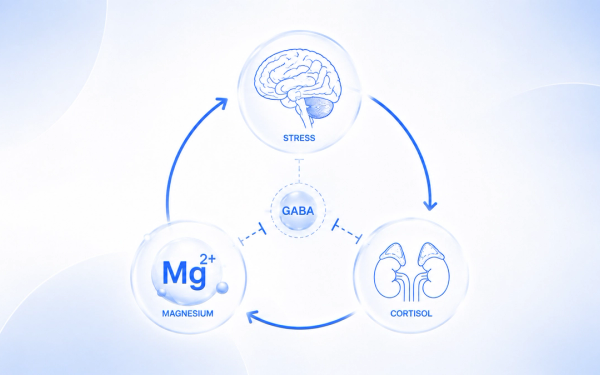
Stress mãn tính làm cơ thể tiêu thụ Magie nhanh gấp đôi. Hiểu cơ chế cortisol - GABA - Magie để giải thích tại sao căng thẳng kéo dài gây thiếu khoáng chất.

Mất ngủ khi mang thai không chỉ do bụng lớn hay đi tiểu đêm. Thiếu Magie và Vitamin D là hai yếu tố ít được nhắc tới nhưng có cơ chế rõ ràng. Bài này giải thích tại sao giấc ngủ thai kỳ bị phá vỡ, hai vi chất này liên quan thế nào, và giới hạn liều an toàn cần biết trước khi bổ sung.