Depression Is Getting Younger: Modern Life Is Stealing What the Brain Needs Most
Look around. What do you see?
Friends in their mid-twenties exhausted but unable to sleep. Young people who look successful on the outside but feel hollow inside. High schoolers carrying the kind of anxiety that used to belong to adults. Conversations that start with "I haven't been doing well lately" becoming more and more common.
The numbers are confirming what we already sense.
A Crisis Unfolding Quietly
The World Health Organization (WHO) estimates that one in seven children and adolescents between the ages of 10 and 19 is living with a mental disorder, accounting for 15% of the global disease burden in this age group. Depression specifically — not passing sadness, but clinical depressive disorder — affects approximately 3.4% of adolescents aged 15 to 19 worldwide.
Data from the Global Burden of Disease Study (GBD 2021) shows that depression rates among those aged 10 to 24 rose continuously from 1990 to 2021, with a sharp spike during the COVID-19 pandemic. By 2040, models project that global cases of depressive disorders could exceed 466 million.
Depression is clearly on the rise. The real question is why — and why it is hitting younger and younger people.
What Modern Life Is Doing to the Brain
Many explanations point to social pressure, social media, or a generation that is "more sensitive." But neuroscience tells a more specific story.
Chronic stress has become the default state. The brain is built to handle short-term stress: a threat, an exam, a conflict. When stress becomes a continuous baseline — relentless deadlines, phone notifications every few minutes, comparing yourself to hundreds of curated lives on social media — the hypothalamic-pituitary-adrenal (HPA) axis never gets to switch off. Cortisol stays chronically elevated, and chronic cortisol causes the hippocampus, the brain's center for emotional processing and memory, to physically shrink.
Screens have replaced sleep. Blue light from phones suppresses melatonin, but the deeper problem is that when adolescents average fewer than 7 hours of sleep — 1 to 2 hours below physiological need — the brain does not have enough time to clear the neural waste products that accumulate during the day, including pro-inflammatory proteins linked to depression.
Processed food has taken over the plate. White rice, fast food, sugary drinks deliver calories but little else. This is where the story turns in a direction that rarely gets enough attention.
Neurotransmitters and the Missing Piece
Clinical depression, from a biological standpoint, is not simply "low serotonin." That model dates to the 1990s and has since been significantly complicated by modern neuroscience.
Current research recognizes at least three layers of biological mechanism.
The first is an imbalance between glutamate (the brain's main excitatory signal) and GABA (its main inhibitory signal). When glutamate dominates unchecked, neurons stay in a state of persistent activation — leading to tension, anxiety, and eventually a kind of cellular burnout.
The second is dysregulation of the HPA axis: cortisol fails to return to baseline and gradually damages the hippocampus and prefrontal cortex.
The third is a decline in BDNF (Brain-Derived Neurotrophic Factor), the brain's growth factor, which impairs the brain's ability to form new connections and recover from stress.
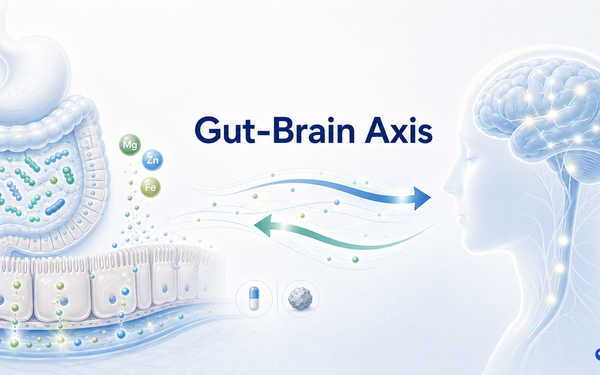
Magnesium plays a regulatory role in all three of these mechanisms.
Magnesium and the Brain: The Connection Rarely Discussed
In The Magnesium Miracle, Dr. Carolyn Dean describes magnesium as the mineral the brain needs to maintain stability — and argues that its deficiency produces symptoms of anxiety and depression at the biochemical level, not merely the psychological one.
NMDA receptors and the magnesium block. NMDA receptors are channels that allow calcium to enter neurons when activated by glutamate. Magnesium acts as a natural plug inside these channels, preventing calcium from flooding in. When the body has adequate magnesium, the brain maintains a healthy balance between excitation and inhibition. When magnesium is depleted, that plug is pulled. Glutamate activates unchecked, calcium pours in, and neurons stay in a state of chronic tension. This is the physiological foundation of chronic anxiety — and a pathway toward depression.
Serotonin depends on magnesium. The synthesis of serotonin, the neurotransmitter most associated with mood stability, requires magnesium as a cofactor. Some research notes that antidepressants (SSRIs) have an indirect effect of raising magnesium levels in the brain, suggesting that part of their action may run through this pathway.
The HPA axis and magnesium. Magnesium helps suppress excessive activation of the HPA axis. When magnesium is low, cortisol escalates without regulation. Murck (2002, PubMed) described magnesium as an endogenous modulator of the stress response system.
Structural brain changes. Chronic magnesium deficiency has been linked to enlargement of the amygdala (the brain's fear and emotional reactivity center) and shrinkage of the prefrontal cortex (the region responsible for rational thought and behavioral control). The brain of someone chronically low in magnesium is, structurally, more reactive and less able to self-regulate.
Clinical Evidence
This is not theoretical. Clinical trials have tested the question directly.
A randomized controlled trial (RCT) published in 2017 (PLOS ONE, Tarleton et al.) enrolled 126 adults with mild-to-moderate depression. After 6 weeks of magnesium chloride supplementation at 248 mg per day, PHQ-9 depression scores dropped by an average of 6.0 points — a clinically meaningful improvement. Anxiety scores fell by 4.5 points.
A meta-analysis published in 2024 (Biological Trace Element Research) pooled seven randomized clinical trials involving 325 people with depressive disorders and concluded that magnesium supplementation produced a statistically significant reduction in depression scores (standardized mean difference: −0.919, p = 0.001).
A cross-sectional study published in 2025 (Nutrients) analyzed NHANES data from 2005 to 2020 across more than 14,000 American adults and confirmed that lower dietary magnesium intake was significantly associated with higher risk of depression, after controlling for confounders.
To be clear: magnesium supplementation is not a replacement for clinical treatment of depression, particularly in severe cases. But the evidence is increasingly consistent that magnesium deficiency is a biological contributor to depression, and that correcting it can help improve symptoms at the mild-to-moderate end of the spectrum.
The Feedback Loop Modern Life Has Created
The most troubling part is that the very things driving depression also deplete magnesium.
Every time cortisol spikes — from a deadline, a social media scroll, a moment of worry — the kidneys excrete more magnesium. Poor sleep reduces magnesium absorption and increases losses. Processed food, white rice, and sugary drinks provide very little magnesium. White rice loses 80 to 90% of its magnesium content during milling compared to whole grain brown rice.
And low magnesium makes the brain more stress-reactive, harder to regulate emotionally, and worse at sleeping — which drives cortisol higher, which depletes magnesium further.
This is the biochemical feedback loop that modern life has quietly built, particularly for young people living in high-pressure urban environments with limited dietary variety.
60 to 70% of the global population does not meet the recommended daily intake of magnesium (310 to 420 mg for adults). Not from laziness — but because a modern food system, mineral-depleted agricultural soil, and a lifestyle that continuously drives excretion have together created a silent but consequential gap.
A Different Way to Look at This
Depression is not weakness. It is not a character failure. And it is not the fate of a generation.
But it is also not a problem that lives entirely in the mind or in social circumstances. Behind every emotional state is a biological substrate: chemical reactions, receptor systems, minerals the body needs to function properly.
When modern life systematically erodes those biological foundations, the answer cannot only be "think more positively" or "be stronger."
Understanding what the body is missing is the first step toward giving it what it needs.
If you or someone you know is experiencing depression, seeing a mental health professional is an essential step. Understanding the underlying biology can make that journey clearer.
This content is educational and not a substitute for medical advice. Consult a professional before changing your supplement regimen.